
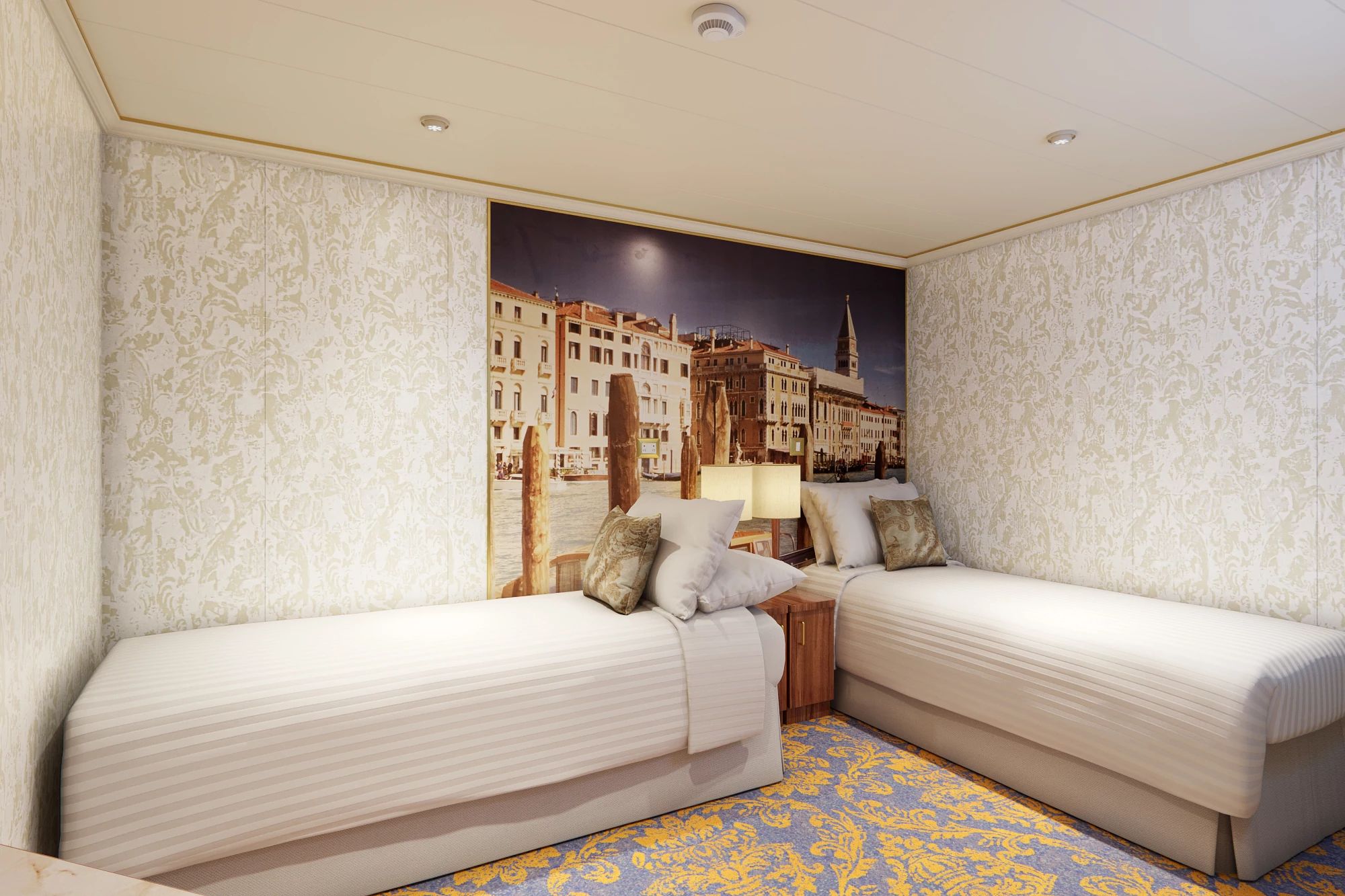
When you’re planning a cruise with a disability or mobility limitations, one of the first and most stressful decisions you have to make is choosing your stateroom. If you search online forums or talk to travel agents, you’ll hear strong opinions on both sides. Some swear you must book a Fully Accessible Cabin (FAC), while others claim a standard cabin works just fine if you have a lightweight or folding mobility scooter.
As someone who was born with spina bifida, walks with limited stamina, and travels with my mobility scooter, I’ve tested these waters firsthand across multiple cruise lines including Royal Caribbean, Princess, Norwegian and Carnival.
If you’re wondering whether you really need to hold out for an accessible cabin on your next sailing, here’s a honest look at how standard cabins compare to Fully Accessible Cabins (FAC), and how to decide which one is right for you.
Accessible Cruise Cabin Types: FAC, FAC-SSA and Standard Staterooms Explained
Cruise lines generally categorize their accessible accommodations into three main buckets:
1. Fully Accessible Cabins (FAC)
These staterooms are designed for guests with severe mobility limitations or those who rely on a wheelchair or scooter full-time.
• The Doorway: Expect wide entry doors (typically 32 to 34 inches) that allow you to drive straight in without squeezing or folding armrests.
• The Layout: Generous floor space with a full 5-foot turning radius around the bed and living area.
• The Bathroom: Roll-in shower with zero threshold, fold-down bench, strategically placed grab bars, and a roll-under sink.
• Balcony (if applicable): Ramp access or a smooth threshold leading out to the veranda.
Check out this video I did of a FAC on Norwegian Epic.
2. Fully Accessible Cabins – Single Side Approach (FAC-SSA)
Similar to standard FAC rooms, these are built for mobility device users but feature an accessible route on only one side of the bed (or between two twin beds). They still offer wide entry doorways and roll-in accessible bathrooms, but floor space around the rest of the cabin is slightly tighter.
3. Standard Cabins
Standard staterooms are designed for able-bodied guests and come with strict physical boundaries.
• The Doorway: Narrow entryways, usually around 22 inches (approx. 55.9 cm) wide.
• The Thresholds: A notable step/lip going into the bathroom (often 8 inches), a 4-inch lip into the shower stall, and a step out onto the balcony.
• The Floor Space: Compact with narrow walkways between the bed, desk, and walls.
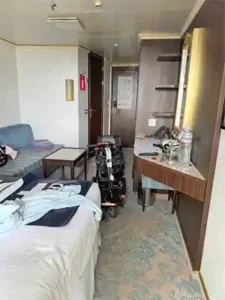
Pictured is a foldable mobility scooter stored in a standard cabin on a cruise ship.
Can a Mobility Scooter Fit in a Standard Cruise Cabin?
On a recent sailing aboard the Carnival Venezia, my wife and I really wanted a balcony room. Fully Accessible Balcony cabins sell out extremely fast so we opted to test a Standard Balcony Cabin to see if my scooter could handle it.
Here is what I learned from that experience:
• Getting Through the Front Door: My scooter is lightweight (under 45 lbs) and relatively narrow, but getting through that 22-inch doorway was a tight squeeze. It required a precise, straight-on approach every single time. If your scooter is wider than standard compact models, or if you use a heavy power chair, a standard cabin door is a non-starter.
• In-Room Parking & Charging: Space inside a standard room is tight. I was able to park and charge the scooter inside without completely blocking the path to the bed, but it definitely ate up valuable floor space.
• The Bathroom Challenge: This is where standard cabins prove tricky. The step up into the bathroom was manageable for me since I can walk short distances, but when the ship was swaying in rougher seas, navigating that high step required extra effort and care. For anyone who cannot step over a high threshold or needs grab bars to transfer, a standard bathroom simply won’t work.
How to Choose the Best Cruise Cabin for Mobility Limitations
Book a Fully Accessible Cabin (FAC) if:
• You cannot step over an 8-inch bathroom lip or a balcony threshold.
• You use a full-size power chair, a heavy-duty scooter, or a non-folding manual wheelchair that requires more than 22 inches of door clearance.
• You require a roll-in shower, fold-down seat, or grab bars for safe bathing.
• You need full 360-degree maneuvering space inside the room to transfer safely from your mobility device to the bed or sofa.
A Standard Cabin Might Work for You if:
• You use a compact, ultra-lightweight folding scooter or a narrow travel wheelchair.
• You have sufficient balance and strength to step over bathroom thresholds and shower lips.
• You only use your scooter for covering long distances around the ship/ports and can walk short steps inside the stateroom.
• Accessible cabins are fully booked, but you still want to take the cruise and are comfortable managing minor tight squeezes.
Bottom Line: Standard vs. Fully Accessible Cruise Cabins
Can you cruise in a standard cabin with a mobility scooter? Yes, if you have the right lightweight gear and moderate ambulatory ability.
However, if peace of mind, seamless transfers, and zero physical barriers are high on your priority list, holding out for a Fully Accessible Cabin is worth every penny. Next time around, we’ll likely target an FAC to enjoy that zero-threshold bathroom ease, especially on high-sea days!
Whatever you choose, don’t let cabin anxiety keep you onshore. Pack your sense of adventure, double-check your scooter dimensions, and hit the high seas!

0 Comments