When you head out on vacation, whether it’s boarding a cruise ship, checking into a resort, or navigating a crowded airport, the goal is simple: unwind, explore, and leave the daily grind behind. But as someone who spends a lot of time writing about travel and paying close attention to accessibility, I see a recurring theme. For travelers with disabilities, navigating these dream destinations often comes with a frustrating stack of preventable obstacles.
Most of the time, the biggest headaches aren’t caused by natural terrain or faulty equipment, they’re caused by well-meaning fellow vacationers who seem to turn off their situational awareness the second they put on flip-flops.
If you want to be a more thoughtful, respectful traveler toward everyone, here are ten things disabled people wish you’d stop doing while on vacation.
1. Using Accessible Stalls and Family Restrooms as Your Personal Dressing Room
We’ve all seen it: someone ducking into the oversized accessible stall or locking up the single-occupancy family restroom at a highway rest stop or airport terminal just because they have three rolling suitcases or want extra space to change into swim trunks.
Why it’s a problem: Accessible stalls and companion family restrooms aren’t luxury upgrades for people who want extra legroom, they are an absolute necessity for many of us. For a wheelchair user or someone with adaptive equipment, standard stalls are physically impossible to use. When non-disabled travelers occupy these facilities for changing or unpacking gear, disabled travelers are left waiting indefinitely for the only option they can safely use.
Rule of thumb: Leave accessible stalls and family restrooms open unless all other stalls are taken, you are assisting someone who requires companion care, or you genuinely need the adaptive grab bars and layout.
2. Hoarding Elevators for One Floor (Especially on Cruise Ships)
If you’ve ever been on a cruise ship during sea days or deck parties, you know elevator banks can look like a contact sport. But watching able-bodied groups crowd onto an elevator just to travel up or down a single flight of stairs while wheelchair users and guests with scooters wait through cycle after cycle is infuriating.
Why it’s a problem: For many disabled travelers, elevators aren’t a shortcut; they are the only way to move between decks, dining rooms, and cabins. While taking the stairs for one floor is a minor effort for most, taking up elevator capacity out of pure laziness directly traps people who have zero physical alternative.
3. Treating the World Like Your Personal Storage Unit (Blocking Ramps & Curb Cuts)
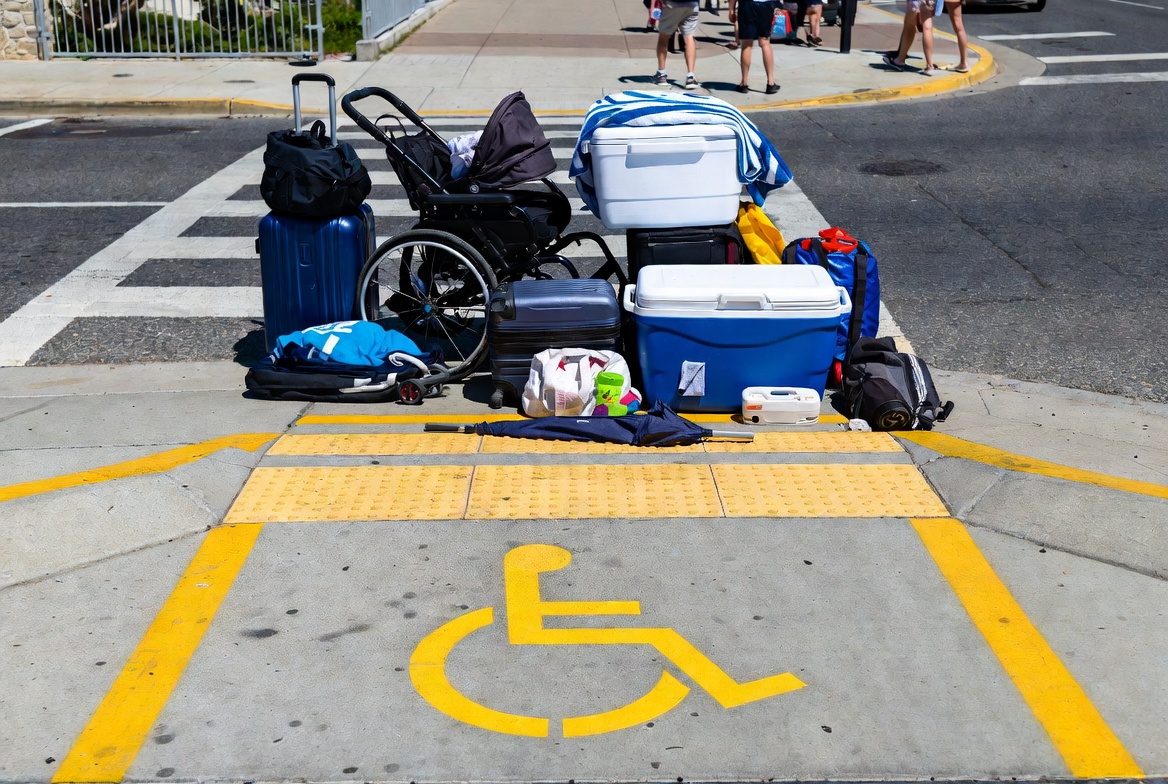
Here is one of my big pet peeves. At resort lobbies, train platforms, and beach boardwalks, space fills up fast. It’s easy to drop a heavy cooler, park a stroller, or leave a stack of luggage on a ramped walkway or curb cut “just for a second” while you get organized.
Why it’s a problem: Ramps and curb cuts are crucial transit arteries. Blocking even a few inches of a ramp can completely stop someone using a power wheelchair, scooter, or walker. Forcing a disabled traveler to ask people to move their stuff, or worse, try to navigate off a steep curb into oncoming resort traffic, is dangerous and unnecessary.
4. Walking Around with Zero Spatial Awareness
I should’ve put this in the number one spot as it’s my single biggest annoyance anytime I take out my scooter. Vacation mode means relaxing, but turning off your personal radar completely creates real hazards. Abruptly stopping in the dead center of a narrow walkway, backing up without looking behind you, or walking three-across down a tight hallway causes major logjams.
Why it’s a problem: Heavy mobility devices like power wheelchairs and scooters cannot stop on a dime, nor can they nimble-step around someone who suddenly shifts into their path. Being oblivious forces wheelchair users to constantly slam on their brakes, maneuver around human obstacles, or risk a collision. Keep an eye on your surroundings so everyone can keep moving smoothly.
5. Distracting Working Service Dogs
We all love dogs! And seeing a well-behaved service dog in an airport lounge, hotel lobby, or national park visitor center is always cool. But making eye contact, baby-talking, whistling, or reaching out to pet the dog while it’s wearing a vest crosses a major line.
Why it’s a problem: Service dogs aren’t pets on vacation; they are working animals performing vital tasks like medical alerting, mobility stabilization, or psychiatric support. Distracting a service dog pulls its focus away from its handler, which can cause them to miss a critical medical cue in an unfamiliar environment. Always ignore the dog completely and speak directly to the human.
6. Grabbing, Pushing, or “Helping” Without Asking First
This lands here with the utmost of respect and appreciation. This behavior usually stems from good intentions: seeing someone in a manual wheelchair struggling with a ramp or negotiating a heavy hotel door and jumping in to grab the handles and push.
Why it’s a problem: Assistive equipment, whether it’s a wheelchair, a white cane, or a walker, is an extension of that person’s physical body and personal space. Unexpectedly grabbing someone’s wheelchair handles can throw off their balance, startle them, or cause a tip-over.
Rule of thumb: Always ask, “Would you like some assistance?” first. If they say “No thanks, I’ve got it,” respect their response and step back.
7. Monopolizing Accessible Seating in Waiting Areas and Lounges
Whether it’s the designated accessible seating areas at airport gates, shuttle bus stops, or pool deck lounges, these spots are clearly marked for a reason. Taking up designated low-transfer seats or the open floor space reserved for wheelchairs just to charge your phone or stretch out is a major oversight.
Why it’s a problem: Accessible seating areas offer specific heights, transfer space, and proximity to boarding doors that people with limited mobility, chronic pain, or wheelchairs require. Forcing someone who can’t stand for long periods to search for alternative seating because you wanted to plug in your laptop is entirely avoidable.
8. Treating Adaptive Features like Play Equipment

Pool lifts, beach wheelchairs, automatic door push-buttons, and boardwalk ramps are engineered to make travel accessible for everyone. Unfortunately, they frequently get treated as toys or shortcuts by kids (and adults who should know better).
Why it’s a problem: Beyond clogging up access for those who need them, playing with specialized equipment like pool lifts or adaptive beach gear causes mechanical wear and tear. If a resort’s only pool lift breaks because kids were riding it like an amusement park attraction, a disabled guest is stripped of their ability to enjoy the pool for the rest of their trip.
9. Blocking Accessible Boarding and Pre-Boarding Areas
Airport gates, cruise embarkation zones, shuttle pickup points, excursion meeting areas, and hotel transportation lines can turn chaotic quickly. When travelers crowd the front, stand in marked accessible boarding spaces, or pile bags in the pathway, it makes an already stressful process harder for the people who need extra room and time to board safely.
Why it’s a problem: Pre-boarding and accessible boarding areas aren’t VIP shortcuts; they exist so disabled travelers can board without being rushed, bumped, or forced to maneuver through a wall of people and luggage. Someone using a wheelchair, walker, cane, or service dog may need clear space to line up, transfer, stow equipment, or communicate with staff. Blocking those areas can delay boarding and create safety risks before the trip even begins.
10. Questioning Whether Someone “Really Needs” an Accommodation
Not every disability is visible, and travel brings out a lot of assumptions. Someone may use priority boarding, accessible seating, a disability access pass, a mobility aid, or a service dog for reasons you can’t immediately see, and they shouldn’t have to defend their needs to strangers in line. In fact, in some cases, it can be a violation of the Americans with Disability Act (ADA).
Why it’s a problem: Interrogating someone about their disability, side-eyeing them for using an accommodation, or demanding proof from a fellow traveler creates shame and hostility in spaces that are already physically and emotionally exhausting. Invisible disabilities, chronic illness, pain conditions, neurodivergence, and medical needs are real whether or not they match your idea of what disability looks like. If staff have approved an accommodation, your job is simple: respect it and keep moving.
Able Travels final thoughts
Creating an accessible travel culture isn’t just up to hotel managers, cruise lines, or airport architects, it comes down to everyday traveler courtesy. By keeping your eyes open, leaving designated spaces clear, and remembering that accessibility features are necessities rather than perks, you can help ensure that vacation spots are genuinely welcoming for every traveler. We are all in this together!
Weigh in! What did I leave off this list or what is your biggest pet peeve about traveling? Leave a comment.

0 Comments