
For decades, travelers with disabilities have been told, directly or indirectly, that air travel simply comes with compromises. As someone who has spent years working at the intersection of travel, accessibility, and real human experience, I’ve seen how those “compromises” often translate into loss of dignity, independence, and confidence long before a plane ever leaves the ground.
That’s why the unveiling of Airbus’s Airspace U Suite stopped me in my tracks.
Accessibility isn’t about special treatment. As Airbus rightly states, “Accessibility means that everyone has the opportunity to engage in the same interactions, enjoy the same services, and acquire the same information, all with the same level of ease and independence.”
That one sentence captures what so many people in the disabled travel community have been saying for years—and what AbleTravels.com is built around.
The Core Problem We’ve Normalized for Too Long
Today, most wheelchair users flying commercially are still required to surrender their personal mobility device at the aircraft door, transfer into an aisle chair, and then transfer again into a fixed aircraft seat. Their wheelchair—often a custom device essential to daily life—travels in the cargo hold.
The result? Over 10,000 wheelchairs are damaged every year in U.S. airports alone, sometimes at repair costs reaching tens of thousands of dollars per incident. Beyond the financial cost, the emotional and physical toll can derail an entire trip—or worse, someone’s independence after they land.
As Dirk Thalheim, an Airbus design engineer and wheelchair user himself, puts it:
“Because your own wheelchair is a vital extension of your body for everyday mobility, having to use an airport chair is genuinely a terrible experience.”
That statement isn’t rhetoric. It’s reality.
Courtesy of AirBus – Airspace U Suite aircraft cabin accessibility
A Cabin Concept That Finally Listens
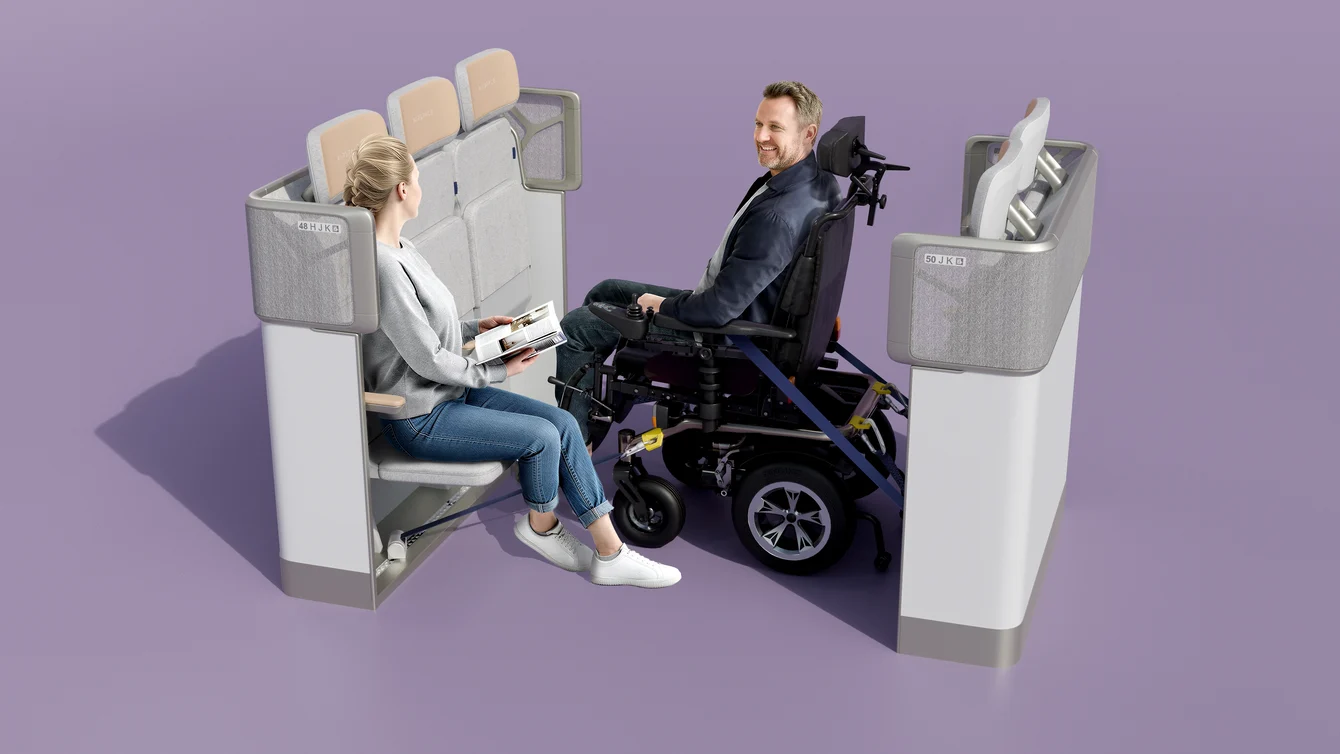
The Airspace U Suite represents something different. Airbus isn’t trying to “fit” wheelchair users into a system that was never designed for them. Instead, they’re proposing a cabin environment that adapts to the passenger.
At its core, the concept allows Passengers with Reduced Mobility (PRMs) to remain in their own wheelchair for the duration of the flight, secured directly to the aircraft floor . That single design choice eliminates forced transfers, dramatically reduces the risk of damaged mobility equipment, and most importantly restores autonomy.
From an AbleTravels perspective, autonomy is the cornerstone of accessible travel. Independence shouldn’t end at the jet bridge.
Universal Design, Not Segregation
What I appreciate most is that Airbus didn’t build the Airspace U Suite as a niche solution. The company emphasizes universal aviation design a flexible cabin space that works for wheelchair users, families, older travelers, and passengers with temporary mobility limitations alike.
This matters because true inclusion doesn’t isolate. It integrates.
Airbus describes the suite as a premium area that benefits all passengers, not just those who identify as PRMs. That philosophy aligns closely with what we advocate at AbleTravels.com: accessibility improvements almost always improve the travel experience for everyone.
Why This Moment Matters
To be clear, the Airspace U Suite is still a concept. Regulatory approval, airline adoption, and real‑world implementation lie ahead. But its importance can’t be overstated.
For over one billion people worldwide living with a disability, air travel represents opportunity and too often, exclusion. When a major aircraft manufacturer publicly commits to redesigning the cabin around accessibility, it signals a shift in priorities across the entire industry.
This is how meaningful change starts: not with apologies after damage occurs, but with design decisions that prevent harm in the first place.
Able Travels Take
At AbleTravels.com, we exist because accessible travel should be practical, dignified, and confidence‑inspiring. Airbus’s Airspace U Suite moves that vision closer to reality—not through charity or accommodation, but through innovation and respect.
The future of air travel should allow travelers to board as themselves, travel as themselves, and arrive as themselves.
This concept proves that future is not only possible—it’s finally being designed.

0 Comments