
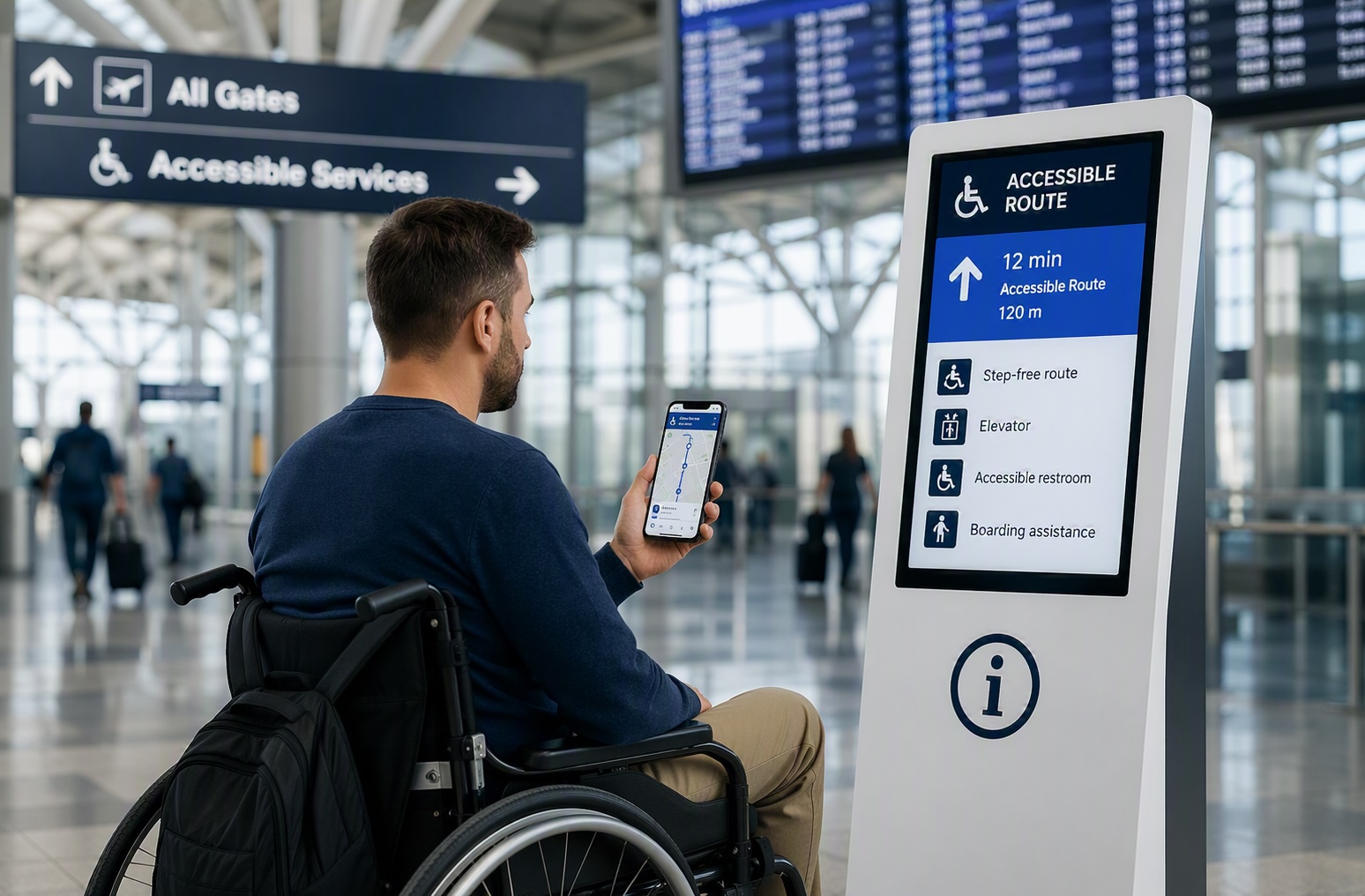
If you’ve been around the travel industry long enough, you’ve heard the phrase “accessible travel is improving” more times than you can count. And for years, that progress has felt incremental at best with new policies here, a ramp there, maybe better training in certain areas.
But in 2026, something different is happening.
This time, the change isn’t just physical. It’s digital. It’s intelligent. And for the first time, technology is taking a real swing at removing barriers rather than just describing them.
From Static Access to Dynamic Mobility
Historically, accessibility has been about infrastructure. Can you get through the door? Is there an elevator? Is the restroom usable?
Those questions still matter but they’re no longer enough.
Today’s innovation is shifting toward how travelers actually move through the world, and that’s where we’re seeing meaningful change. Cities and travel providers are adopting systems that don’t just meet accessibility standards, they adapt to individual needs in real time.
Think about that for a second: instead of a static definition of “accessible,” we’re moving toward personalized accessibility.
And that’s a game changer.
Smarter Tools, Better Trips
One of the biggest developments is the rise of AI-powered navigation and mobility tools. These platforms are designed to analyze real-world conditions such as traffic, sidewalks, crowd levels and guide travelers along routes that minimize barriers like stairs or uneven terrain.
For someone using a wheelchair or mobility scooter, this isn’t just a convenience. It’s the difference between confidence and uncertainty.
We’re also starting to see connected transportation systems play a larger role. Instead of treating each part of a journey separately, cities are linking transit, infrastructure, and digital services into a more seamless experience.
That means better coordination between:
• airports
• local transit
• pedestrian pathways
The goal? Fewer surprises—and fewer workarounds.
Devices Are Getting Smarter Too
It’s not just apps and systems. The hardware is evolving alongside them.
Travelers now have access to a growing range of adaptive mobility devices, from foldable scooters to more advanced, multifunctional wheelchairs.
What’s important here isn’t just portability, it’s flexibility. These tools are being designed with real travel scenarios in mind:
• navigating airports
• handling uneven outdoor terrain
• transitioning between different modes of transport
In other words, the equipment is finally catching up to the realities of travel.
Accessibility That Benefits Everyone
Here’s something the industry is starting to understand: when you design for accessibility, you rarely benefit just one group.
The same systems that help a traveler with a disability can also help:
• older adults
• families with strollers
• travelers recovering from injuries
Smart mobility infrastructure, like adaptive crossings, clearer routing, and better path planning, is improving the experience across the board.
And that’s part of why investment is accelerating. Accessibility is no longer being treated as a niche requirement. It’s becoming a universal design principle.
Not a Silver Bullet, But a Real Shift
Let’s be clear: technology isn’t solving everything.
Physical barriers still exist. Airline policies are still catching up. And consistency across destinations remains a major challenge.
But what’s different now is the direction of progress.
For years, accessible travel relied heavily on human intervention like calling ahead, confirming details, double-checking arrangements. That’s not going away anytime soon, but it’s being supplemented by systems that can provide real-time clarity instead of guesswork.
And that shifts the experience in a meaningful way.
The Bigger Picture
If you zoom out, what we’re seeing in 2026 is the early stage of something larger.
Accessible travel is moving from:
• compliance → to experience
• infrastructure → to ecosystems
• reactive fixes → to proactive planning
Technology is enabling that shift by connecting the dots (literally and figuratively) between the different parts of a journey.
For travelers who’ve had to plan every detail just to avoid barriers, that kind of integration isn’t just helpful.
It’s empowering.
AbleTravels Final Thoughts
There’s still plenty of work to be done. But for the first time in a while, the momentum feels different.
Not because the industry is talking about accessibility more.
But because it’s starting to build it in, intelligently, from the ground up.
And that’s the kind of change that doesn’t just improve travel.
It opens it up.

0 Comments